
1. The Problem: Hidden Methane in Thai Rice Fields
Thailand’s agriculture sector is a significant source of greenhouse gas emissions, contributing 15.23% of the country’s total emissions. The main issue comes from rice cultivation. Traditional practices that keep fields continuously flooded create anaerobic soil conditions, which produce large amounts of methane (CH₄).
Methane is 85 times more potent than CO₂ in the short term, making rice paddies the largest agricultural source of greenhouse gases, accounting for 50.58% of emissions in the sector.
2. The Solution: Alternate Wetting and Drying (AWD)
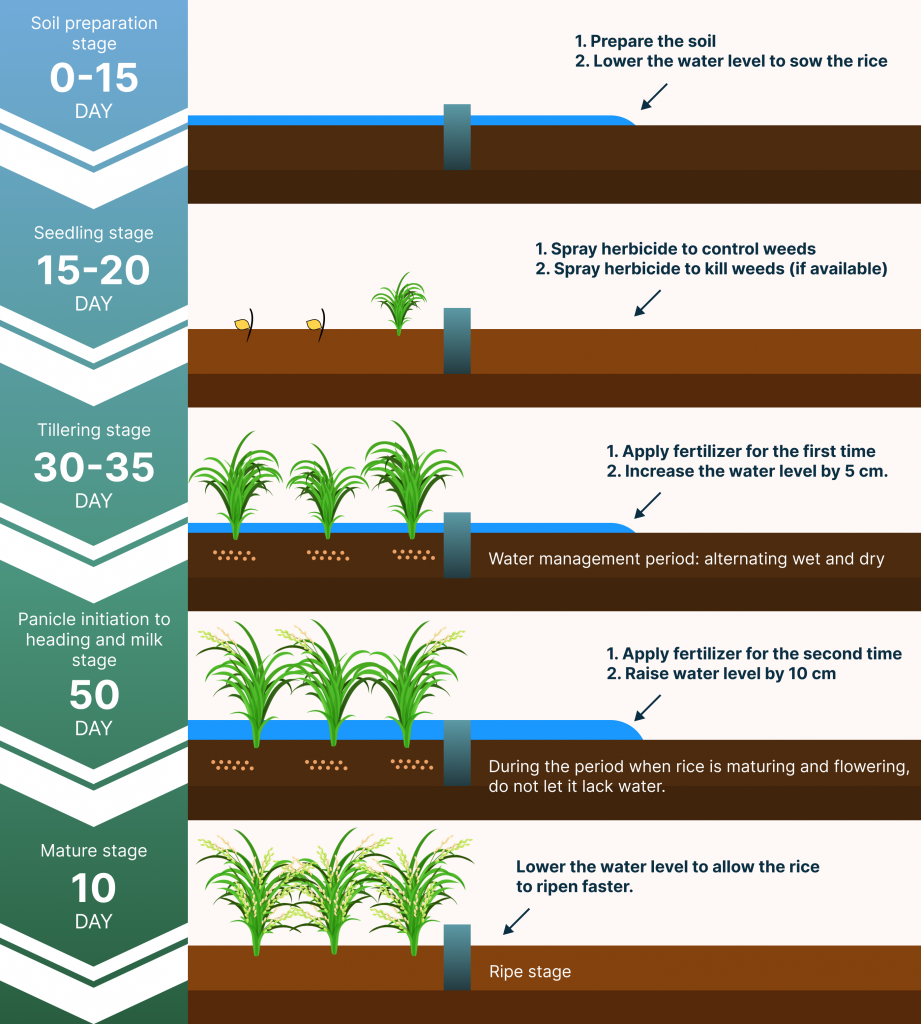
AWD (Alternate Wetting and Drying) is a water management technique for rice paddies that differs from permanently flooded methods. Water is allowed to rise and recede periodically.
How it works:
- Allowing the soil to dry between flooding periods lets air penetrate the soil, preventing conditions favorable for methane production.
Benefits:
- Methane reduction: Cuts methane emissions by up to 50%.
- Water savings: Reduces water usage by 15-35%, with some studies in Thailand showing reductions up to 90%.
- Agricultural economics: Maintains crop yields and, in some cases, lowers production costs while increasing productivity.

3. Smart Farm Applications: From Practice to Carbon Credit Value
Historically, AWD was seen primarily as a cost-saving practice. Today, Smart Farming technology transforms it into a measurable value by linking AWD to carbon credits. When farmers reduce methane emissions, the reductions can be quantified and converted into tradable carbon credits.
Creating premium-quality carbon credits requires precise Monitoring, Reporting, and Verification (MRV). Smart Farming, especially Digital MRV (dMRV), replaces manual farmer records with highly accurate data, such as:
- Satellite imagery to verify AWD water patterns
On-ground sensors (Tier 3) to directly measure results, ensuring reliable data
4. Case Study in Thailand: Premium T-VER in Kamphaeng Phet
A notable Thai example is the Premium T-VER program, a voluntary high-quality carbon credit initiative supported by the government.
Implementation:
- Green Carbon, a Japanese company, piloted AWD in Kamphaeng Phet under the Premium T-VER scheme.
- Goal: Reduce approximately 450,000 tons of CO₂e over five years.
Significance: This project demonstrates that AWD is not just theoretical but has been adopted at a national policy level to address methane emissions from rice cultivation.Reference:Green Carbon’s AWD project in Kamphaeng Phet under Thailand’s Premium T-VER scheme
5. Supporting Technology: Satellites Tracking Greenhouse Gases
Scaling Smart Farming nationwide requires technologies with broad visibility, which is satellites. While on-ground sensors provide precise data, they are costly and difficult to scale. Satellites offer a cost-effective way to monitor regional or global methane emissions.
Examples of satellites used in monitoring AWD and greenhouse gases:
| Satellite / Project | Country / Organization | Key Mission & Data | Current Status |
| GOSAT-GW (Ibuki-2) | Japan (JAXA) | Measure greenhouse gases (CO₂, CH₄) and water cycles; TANSO-3 sensor | Launched 29 June 2025, operational |
| Sentinel-5P | EU (ESA) | Monitor tropospheric air pollution & GHGs; TROPOMI sensor, resolution 7 km × 3.5 km | Launched 13 Oct 2017, continuous operation |
| Carbon Mapper | USA (Coalition) | Identify “Super-Emitters” of CH₄ & CO₂ for rapid mitigation | Operational, using satellites & aircraft |
| MicroCarb | France (CNES) | High-precision global CO₂ mapping (accuracy ~1 ppm) | Launched July 2025, data collection phase |
6. Conclusion: The Future of Sustainable Rice Farming with Smart Farms
AWD offers three major benefits: reducing greenhouse gas emissions, conserving water, and improving farmers’ income or security.
If traditional rice cultivation is like filling a field with a bucket, AWD combined with Smart Farming is like using a smart tap with precise sensors. Strategically opening and closing the tap (AWD) not only saves water but also converts methane reductions into tradable carbon credits.
This approach aligns with the Thai government’s policy to expand sustainable practices across major agricultural regions.